This area around was the site of a thriving
monastery for over three centuries, from 1237 to 1538. Today the largely hidden
remains of the once‑impressive friary are protected as a Scheduled Monument.
Look out for the part of the friary precinct wall, which still stands close to the edge of the site. It was probably built in the 1500s and may have replaced an earlier boundary. Parts of this wall were restored by the City Council in 2025 in partnership with Heritage England. There are very few visible remains of the friary buildings, but centuries of archaeological work — sometimes planned, sometimes accidental — have revealed much of what we know today.
The friary began life as a small timber building. Lichfield was an important centre of Franciscan activity. The friars were a mendicant order, relying on the charity of others and living modest lives. Their simple lifestyle contrasted with the growing wealth of the medieval church. The Lichfield friary continued to expand, and by the early 1300s it had become one of the largest Franciscan houses in England. Its church was 240 feet long — almost as long as Lichfield Cathedral’s nave.
In 1538 Henry VIII ordered the dissolution of the monasteries. The friary was closed down and most of its buildings were demolished. The land was later used for agriculture and housing until the 20th century.
In 1933, after the demolition of nearby buildings, Councillor Thomas Moseley secured permission to carry out an archaeological excavation of the site.
In 1936 the area was turned into a public park, leading to the site becoming a Scheduled Monument. Further excavations took place in the 1950s, and 1990.
The site of the remains of the Friary is now a public garden owned and managed by Lichfield City Council. The portico was added in 1937 to provide an entrance to the ruins and was originally sited at Shenstone Court.
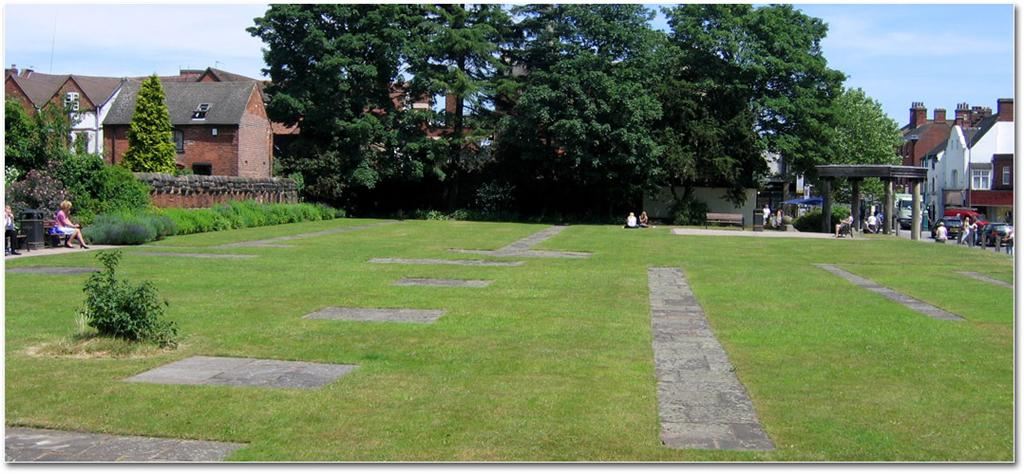 Friary Remains